

This blog explains why a well-defined SEO strategy is no longer optional but a core growth channel for businesses looking to increase visibility, traffic, and revenue. At Palmer Ad Agency, SEO is positioned as a long-term, data-driven marketing investment that aligns content, keywords, and user intent to consistently outperform competitors in search results.
An effective SEO strategy goes beyond ranking on Google—it helps brands attract high-intent users, strengthen authority through quality content and backlinks, and continuously adapt to evolving search engine algorithms. The blog also highlights why partnering with SEO professionals delivers stronger ROI than relying solely on tools or short-term tactics.
Key Takeaways:
- Organic search drives the majority of website traffic and sales opportunities
- Ranking on page one requires strategic keyword research, quality content, and consistency
- SEO improves brand awareness, credibility, and competitive positioning
- Successful SEO is a long-term process that compounds results over time
- Working with experienced SEO specialists ensures adaptability, performance tracking, and sustainable growth
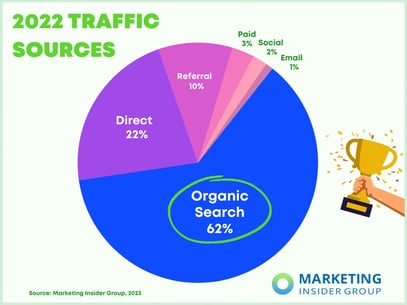
That’s why search engines have become powerful tools for increasing traffic. Organic search accounted for 62% of traffic in 2022—more than referrals, paid ads, social media and email combined. Organic search accounted for 62% of traffic in 2022—more than referrals, paid ads, social media and email combined.
With those kind of numbers, everyone wants to top search engine results pages (SERPs)—and your business should too. Otherwise, your competitors will and you’ll miss out big time on sales opportunities.
But appearing on the first SERP doesn’t just happen. It takes a concerted effort between businesses and SEO specialists to customize, implement and continue a proper SEO strategy. With online searching only increasing (up from 58% in 2019), an SEO strategy should be one of your marketing priorities in the new year.
Why SEO is critical
Just in case we haven’t already convinced you in the introduction that you need an SEO strategy, here are a few more reasons.
- More people will find you. Prospects who otherwise may not know anything about your products or services can discover you when your SEO keywords match their search terms. This helps increase brand awareness (including for those with a local customer base) while casting a narrower net than some forms of advertising by drawing more visitors to your business whose queries pair with the information you have on your site. More targeted traffic equals better opportunities to covert and make sales.
- SEO increases your PR and marketing efforts. A big part of SEO is creating high-quality content that entices publications and other sources to link and reference. When search engines see that your thought leadership content is backlinked, it signifies that you are a trusted source. The data you gather through your SEO efforts also can help you better understand your audience, improving your digital marketing.
- You’ll enhance your competitiveness. Other companies are likely drawing people to their websites by using SEO keywords in your industry. In your own SEO work, you can see how they’re attracting visitors and use that information to inform your own strategy, swaying some of that traffic back to your brand.
These are just some of the many benefits you will realize when you engage in SEO activities.

What you can expect when building a strategy
One of the first steps of building an SEO strategy involves researching keywords around your audience's pain points to determine what kinds of terms they’re searching.
It’s important to know that an effective SEO strategy requires investment in creating content—whether you choose to do that internally or hiring out help—around those keywords and searches. Helpful blogs, articles, whitepapers, webpages, videos, and other pieces that answer search queries will improve your SEO and drive clicks.
Note that this isn’t about putting up one or two articles and then calling it quits. Consistently posting more and up-to-date information will help increase your rankings over time while creating credibility with your target audience. That’s why it’s also important to understand that SEO is a long-term strategy that may take a year or two of continuous work to realize the full benefits. But if you create a strong SEO strategy and stick with it, you will see results.
How a professional can help
Although there are SEO tools available, you can waste time and money trying to get up to speed. Like most aspects of digital marketing, SEO is its own animal. As search engines constantly adjust their algorithms—many of which are not publicly shared—staying up to date on the latest developments and best practices requires a lot of attention.
For most companies, working with an SEO specialist whose job is to keep up with the latest research and development and has vast knowledge of how SEO works and what strategy could work best for you is likely to generate the best ROI. Not only can an expert help you build and implement your strategy, but also provide the continuous monitoring and analysis critical to refining your approach and driving your success.
While SEO continues to evolve, one constant is that as long as people are searching, SEO will remain an important marketing priority for today’s businesses.
To learn more and discover how Palmer can help customize your SEO strategy,
Frequently Asked Questions
1. Why is an SEO strategy important for businesses in 2026?
An SEO strategy is critical because most customers begin their buying journey with online searches. Without a structured SEO approach, businesses risk losing visibility, traffic, and conversions to competitors who are actively investing in search optimization.
2. How does SEO help increase qualified traffic?
SEO targets users who are actively searching for specific solutions. By aligning keywords with audience pain points, SEO brings in more relevant, high-intent traffic that is more likely to convert into leads or sales.
3. Is SEO a short-term or long-term marketing strategy?
SEO is a long-term strategy. While early improvements may be visible within months, meaningful and sustainable results typically require consistent effort over 6–24 months, including content creation, optimization, and performance tracking.
4. What role does content play in an SEO strategy?
Content is the foundation of SEO. Blogs, landing pages, videos, and resources that answer user questions help improve rankings, earn backlinks, and build authority with both search engines and potential customers.
5. Can businesses manage SEO on their own using tools?
While SEO tools can provide insights, they cannot replace expertise. SEO requires ongoing analysis, algorithm awareness, and strategic execution. Without professional guidance, businesses often waste time and budget on ineffective tactics.
6. How does working with an SEO agency improve ROI?
An experienced SEO agency like Palmer Ad Agency brings industry knowledge, proven frameworks, and continuous optimization. This ensures strategies are aligned with search engine updates, business goals, and measurable performance outcomes.
7. Will SEO remain relevant in the future?
Yes. As long as people rely on search engines to find information, products, and services, SEO will continue to be a core digital marketing priority—adapting in form but not in importance.